Dr. Maria Montessori
The revolutionary educator whose method has shaped millions of children's lives across 150+ countries.
The Pioneer
Who Was Maria Montessori?
One of the most influential educators in history — a physician, scientist, and champion of children.
Maria Montessori (1870–1952) was an innovative Italian educator, physician, and entrepreneur who revolutionised childhood education through her groundbreaking method. Despite significant societal barriers, she became one of Italy's first female physicians.
She observed that children learn best when free to explore in a well-prepared environment. Her first school, "Casa dei Bambini" (Children's House), opened in 1907 in Rome. Today, Montessori education is followed in more than 150 countries.
Learn by using real materials — not just books
Work at their own pace
Develop confidence, independence, and discipline naturally
Grow a love for learning — not fear of exams
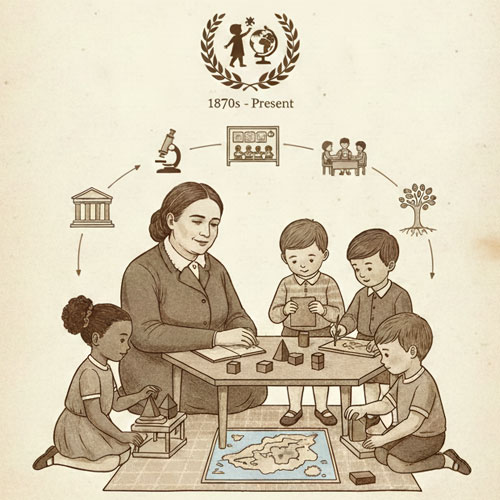
“The goal of early childhood education should be to activate the child's own natural desire to learn.”
— Dr. Maria Montessori
The Method
Core Principles
The foundational pillars that make Montessori education unique and extraordinarily effective.
Prepared Environment
A carefully designed classroom space that supports independence, exploration, and learning at every level.
Sensorial Learning
Children learn through their senses, using specially designed materials to explore concepts concretely.
Child-Centered Learning
Education follows the child's interests and developmental pace, not a predetermined curriculum.
Practical Life Activities
Real-world tasks help develop fine motor skills, concentration, and independence from an early age.
Mixed-Age Groups
Children of different ages learn together, fostering collaboration, empathy, and peer learning.
Teacher as Guide
The educator observes and guides rather than directs, supporting each child's natural development.
Career Impact
For Teachers
Montessori training is not just a course — it's a career-building journey that gives you a completely new lens for understanding children and education.
Gives deep understanding of child psychology and behavior
Teaches how to manage classrooms calmly and effectively
Helps teachers design activity-based, engaging lessons
Opens career opportunities in India and internationally
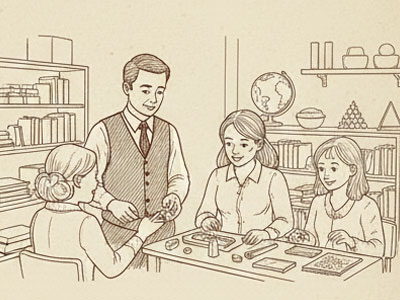
“The greatest sign of success for a teacher is to be able to say, 'The children are now working as if I do not exist.'”
— Dr. Maria Montessori
Free Awareness Programme
What You Will Discover
Attend our free Montessori awareness session and walk away with clarity on your path forward.
Understand how Montessori education differs from traditional teaching
Know the career scope and job opportunities available
Learn about course structure, duration, and eligibility
Interact with experienced trainers and successful alumni